

Voice AI for Indian Businesses: Complete Guide to Implementation and Benefits
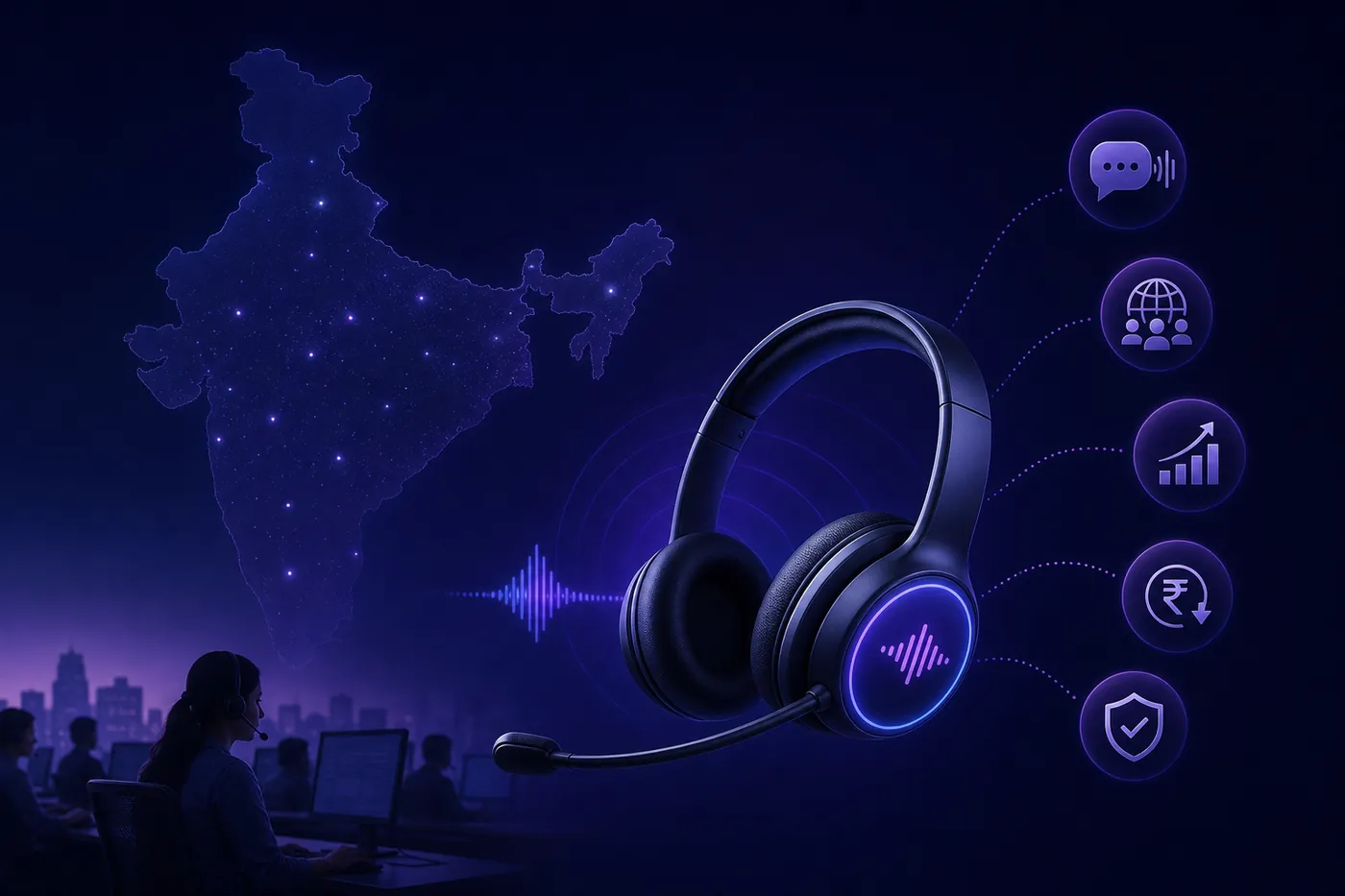
Indian businesses face unique customer service challenges that make voice AI particularly valuable in this market. The linguistic diversity across India creates multilingual support requirements that are expensive and complex to staff with human agents. Rapid digital transformation has increased customer expectations for instant, always-available service. Cost pressures in competitive markets demand efficiency improvements. Meanwhile, the growing middle class and expanding digital economy create surging customer service volumes that traditional approaches struggle to handle.
Voice AI technology addresses these challenges by providing multilingual phone support that operates around the clock at a fraction of traditional costs. Indian businesses across e-commerce, fintech, healthcare, education, and professional services are implementing voice AI to scale customer service, reduce costs, and improve customer experiences. This comprehensive guide explores how voice AI works in the Indian context, implementation strategies, cost analysis, and real-world examples from Indian businesses.
The Indian Market Context for Voice AI
Understanding the specific characteristics of the Indian market helps frame why voice AI delivers exceptional value here.
Linguistic Diversity
India's twenty-two officially recognized languages and hundreds of dialects create complex support requirements. Businesses serving pan-India markets must support Hindi, English, Tamil, Telugu, Bengali, Marathi, Gujarati, and other regional languages. Hiring and training multilingual human agents is expensive and difficult, particularly for smaller businesses.
Modern voice AI systems handle multiple Indian languages fluently, enabling single systems to serve diverse customer bases. This multilingual capability at no additional cost represents transformative value for Indian businesses.
Cost Sensitivity
Indian businesses operate in highly competitive markets with significant price pressure. Customer service costs must be minimized while maintaining quality. Traditional call center staffing, even with India's relatively lower labor costs compared to Western markets, represents substantial ongoing expenses.
Voice AI reduces support costs by sixty to seventy-five percent compared to human agents while improving availability and consistency. This cost advantage is particularly compelling in price-sensitive Indian markets.
Mobile-First Customer Base
India's digital revolution happened primarily through mobile phones rather than desktop computers. Customers are comfortable with phone-based interactions and often prefer calling to using websites or apps. This phone-centric behavior makes voice AI especially relevant for Indian businesses.
Rapid Growth and Scaling Challenges
Indian startups and SMEs often experience rapid growth that strains customer service capacity. Traditional hiring cannot keep pace with explosive growth, creating service quality issues during critical expansion phases. Voice AI scales instantly without hiring delays, enabling businesses to maintain service quality during rapid growth.
24/7 Expectations
Indian customers increasingly expect round-the-clock service, influenced by global digital platforms that never close. Providing twenty-four-seven human support requires three shifts with significant cost implications. Voice AI delivers always-available service at single-shift costs.
Key Use Cases for Voice AI in Indian Businesses
Different sectors in India are deploying voice AI for specific applications that address their unique needs.
E-commerce and Retail
Indian e-commerce businesses handle massive order volumes with tight margins. Voice AI manages order status inquiries, delivery tracking, return requests, and product questions. During festival seasons like Diwali when order volumes spike dramatically, voice AI handles the surge without requiring temporary staff.
Cash-on-delivery, popular in India, creates additional customer service needs around payment confirmation and delivery coordination. Voice AI can handle these interactions efficiently.
Fintech and Banking
Financial services companies use voice AI for account inquiries, transaction verification, balance checks, and basic banking operations. The technology handles customer authentication, provides account information, and processes routine requests while maintaining security and compliance.
Loan and credit card companies deploy voice AI for application status checks, payment reminders, and basic account servicing. This reduces call center costs while improving customer access to information.
Healthcare and Telemedicine
Healthcare providers use voice AI for appointment scheduling, prescription refills, basic health information, and triage. The system can check doctor availability, book appointments, send reminders, and collect patient information before consultations.
Telemedicine platforms leverage voice AI to handle patient intake, schedule consultations, and provide post-appointment follow-up. This improves accessibility while reducing administrative burden.
Education and EdTech
Educational institutions and EdTech companies use voice AI for admission inquiries, course information, enrollment support, and student services. The system can answer questions about programs, fees, eligibility, and application processes.
Coaching centers and test preparation companies deploy voice AI to handle student queries about schedules, materials, doubt resolution, and administrative matters.
Travel and Hospitality
Travel agencies and booking platforms use voice AI for reservation inquiries, booking modifications, cancellation requests, and travel information. The system can check availability, process bookings, and handle routine changes.
Hotels and hospitality businesses deploy voice AI for reservation management, guest services, and information requests. This improves guest experience while reducing front desk workload.
Professional Services
Consulting firms, legal services, and accounting practices use voice AI for client intake, appointment scheduling, basic information requests, and follow-up. The system qualifies leads, collects necessary information, and schedules consultations with appropriate professionals.
Multilingual Capabilities for Indian Markets
The ability to support multiple Indian languages represents one of voice AI's most valuable features for Indian businesses.
Supported Indian Languages
Leading voice AI platforms now support Hindi, English, Tamil, Telugu, Bengali, Marathi, Gujarati, Kannada, Malayalam, Punjabi, and other major Indian languages. The AI can detect which language the customer is speaking and respond appropriately.
Some advanced systems handle code-switching, where customers mix languages within conversations (like Hindi-English or Tamil-English combinations common in urban India). This natural language mixing capability improves user experience.
Accent and Dialect Handling
Voice AI trained on Indian speech patterns accurately understands regional accents and pronunciation variations. This is critical given the diversity of English and Hindi accents across different Indian states.
The technology continues improving as it processes more Indian conversations, becoming better at understanding regional variations over time.
Language Selection Options
Businesses can configure voice AI to offer language selection at the start of calls, allowing customers to choose their preferred language. Alternatively, the AI can automatically detect language from the customer's first few words.
This flexibility ensures customers can interact in their comfortable language, improving satisfaction and comprehension.
Cost Analysis for Indian Businesses
Understanding the economics of voice AI versus traditional call centers helps Indian businesses evaluate ROI.
Traditional Call Center Costs in India
Customer service agents in India typically cost between three to six lakh rupees annually including salary, benefits, training, infrastructure, and management overhead. Tier-2 and Tier-3 cities offer lower costs than metros but still represent substantial ongoing expenses.
A small call center with five agents handling business hours support costs approximately twenty to thirty lakh rupees annually. Extending to twenty-four-seven coverage triples staffing requirements and costs.
Infrastructure including phone systems, computers, workspace, and management adds approximately one to two lakh rupees per agent annually.
Voice AI Costs in India
Voice AI platforms typically charge between fifteen thousand to one lakh rupees monthly depending on call volume and features. Annual costs range from two to twelve lakh rupees.
Implementation costs including setup, integration, and training typically range from one to three lakh rupees as one-time investment.
Ongoing management requires minimal staff time, perhaps ten to twenty hours monthly, adding minimal cost.
Cost Savings Calculation
For a business handling three thousand monthly customer calls, traditional approach requires approximately five agents at twenty-five lakh rupees annually. Voice AI handling the same volume costs approximately six lakh rupees annually including platform fees and management.
This represents seventy-six percent cost reduction and annual savings of nineteen lakh rupees. Payback period is typically three to six months.
For businesses requiring twenty-four-seven coverage, savings are even more dramatic. Traditional approach requiring fifteen agents costs seventy-five lakh rupees annually. Voice AI costs remain at six lakh rupees, representing ninety-two percent cost reduction.
Implementation Roadmap for Indian Businesses
Successfully deploying voice AI in Indian business context requires systematic approach.
Phase 1: Assessment and Planning (Week 1-2)
Analyze your current call volume, types of inquiries, and language requirements. Identify which languages you need to support and what percentage of calls fall into each language.
Document your most common customer inquiries and current handling processes. This information guides voice AI training and configuration.
Define success metrics including cost per call, automation rate, customer satisfaction, and response times.
Phase 2: Platform Selection (Week 3-4)
Evaluate voice AI platforms based on Indian language support, pricing for Indian market, integration capabilities with your systems, and vendor support in Indian time zones.
Verify that platforms accurately handle Indian accents and language mixing common in your customer base. Request demos with your specific language requirements.
Consider data residency and compliance requirements if you handle sensitive customer information.
Phase 3: Implementation and Integration (Week 5-8)
Set up your voice AI platform and integrate with your existing systems including CRM, order management, customer database, and knowledge base.
Configure language options and train the AI on your specific business information, products, policies, and common scenarios in each language you support.
Set up phone number routing so customer calls reach the voice AI system. Most businesses maintain existing numbers while routing them to the new system.
Phase 4: Testing and Refinement (Week 9-10)
Conduct thorough testing in all supported languages. Have native speakers test conversations to ensure natural, accurate interactions.
Test integration with your business systems to verify the AI can access customer information, order details, and other data needed for effective service.
Pilot with limited call volume to identify issues before full launch. Monitor closely and refine based on real interactions.
Phase 5: Launch and Optimization (Week 11+)
Gradually roll out to full call volume. Continue monitoring performance metrics and conversation quality.
Review calls that escalate to human agents to identify improvement opportunities. Expand the AI's capabilities to handle additional scenarios.
Gather customer feedback and adjust based on their experiences. Continuous optimization improves performance over time.
Regulatory and Compliance Considerations
Indian businesses must consider regulatory requirements when implementing voice AI.
Data Privacy and Security
Ensure voice AI platforms comply with Indian data protection regulations. Customer call recordings and personal information must be handled securely.
If you handle sensitive information like financial data or health records, verify that the platform meets relevant security standards and compliance requirements.
Recording and Consent
Indian regulations require informing customers that calls are being recorded. Voice AI systems should include appropriate disclosures at the beginning of calls.
Maintain records of customer consent where required by sector-specific regulations.
Language and Accessibility
Ensure you provide support in languages required by your customer base and any regulatory requirements for your sector.
Consider accessibility needs for customers with hearing or speech difficulties.
Success Stories from Indian Businesses
Real examples from Indian companies demonstrate achievable results.
A Mumbai-based e-commerce company handling eight thousand monthly calls implemented voice AI for order tracking and returns. The system handles seventy-one percent of calls in Hindi, English, and Marathi automatically. Annual cost savings of thirty-two lakh rupees enabled investment in growth initiatives.
A Bangalore fintech startup used voice AI for customer onboarding and account inquiries. Supporting English, Hindi, Kannada, and Tamil, the system handles sixty-four percent of calls automatically. Customer satisfaction scores increased from 3.8 to 4.4 out of 5 due to faster response times and twenty-four-seven availability.
A Delhi-based healthcare chain deployed voice AI for appointment scheduling across fifteen clinics. The system handles appointment booking, rescheduling, and reminders in five languages. Administrative staff time spent on phone scheduling decreased by seventy-eight percent, allowing focus on in-person patient care.
A Chennai EdTech company implemented voice AI for student inquiries about courses, schedules, and admissions. Supporting Tamil and English, the system handles eighty-two percent of routine inquiries automatically. This enabled the company to scale from five thousand to twenty thousand students without proportionally increasing support staff.
Choosing the Right Voice AI Platform for Indian Businesses
Selecting appropriate platform requires evaluating India-specific factors.
Language Support
Verify the platform supports all languages you need with high accuracy for Indian accents. Test with native speakers before committing.
Check whether the platform handles code-switching if your customers mix languages.
Pricing for Indian Market
Ensure pricing is appropriate for Indian business budgets. Some global platforms price for Western markets and are not cost-effective for Indian businesses.
Understand how pricing scales with call volume and whether there are hidden costs.
Local Support and Service
Evaluate whether the vendor provides support during Indian business hours. Time zone differences can create challenges with global vendors.
Check if implementation and training support is available in India.
Integration Capabilities
Verify the platform can integrate with systems common in Indian businesses. Support for Indian payment gateways, local CRM systems, and regional platforms matters.
Data Residency
If data residency in India is important for your business or sector, confirm the platform can meet this requirement.
Conclusion
Voice AI represents transformative technology for Indian businesses, addressing the unique challenges of linguistic diversity, cost pressure, and rapid growth that characterize this market. The combination of multilingual capabilities, dramatic cost reduction, and instant scalability makes voice AI particularly valuable in the Indian context.
Indian businesses across sectors are successfully implementing voice AI to improve customer service while reducing costs. The technology has matured to handle Indian languages, accents, and conversation patterns effectively, making implementation straightforward and results measurable.
For Indian businesses struggling with customer service costs, multilingual support requirements, or scaling challenges, voice AI offers a proven solution that delivers results within months. The cost savings alone typically justify investment, while improvements in availability, consistency, and customer satisfaction provide additional value.
As India's digital economy continues expanding and customer expectations rise, voice AI will become increasingly essential for businesses that want to deliver excellent service at sustainable costs.
Ready to transform your customer support? Start your free trial with Jaano.ai and experience the future of AI-powered customer service.